POLLUX
Designed to deliver the optimal balance between energy resolution, count rate, and active area, POLLUX sets a new benchmark for performance and versatility.
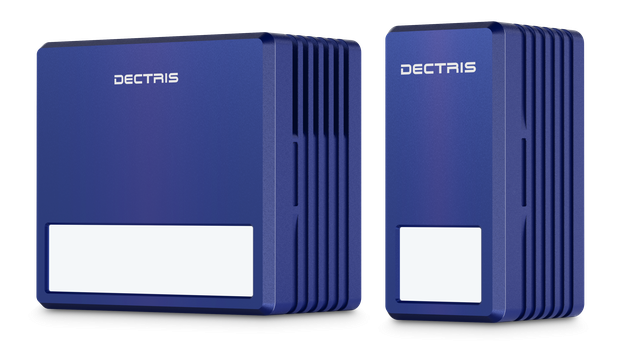
POLLUX™ is the laboratory detector that redefines what you can expect from compact, energy-discriminating X-ray detection. Whether you’re integrating it into a next-generation instrument or want to run fast measurements of high-quality data in the lab, POLLUX delivers exceptional results - consistently and effortlessly.
Designed to deliver the optimal balance between energy resolution, count rate, and active area, POLLUX sets a new benchmark for real-world performance. With dual energy discrimination and excellent resolution, POLLUX effectively suppresses fluorescence and high-energy background, providing clearer signals and better peak-to-background ratios. Its large active area captures more of the beam and covers a wider angular range, enabling faster measurements and improved data quality. Thanks to its superior count rate capabilities, POLLUX enables accurate measurement of high intensities and supports absorber-free reflectometry experiments.
- ✓ Excellent energy resolution and dual energy discrimination for effective background suppression.
- ✓ Superior count rates for unparalleled dynamic range.
- ✓ Versatile and easy to integrate thanks to compact design and passive air cooling.
Detectors
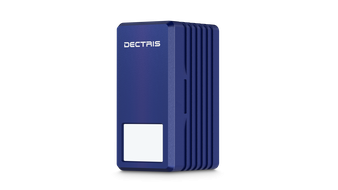
POLLUX
Designed to deliver the optimal balance between energy resolution, count rate, and active area, POLLUX sets a new benchmark for performance and versatility.
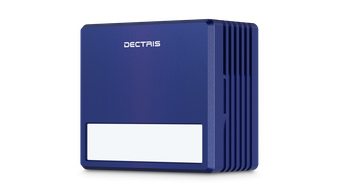
POLLUX PANORAMA
With a large active area of 57.9 by 14.4 mm, POLLUX PANORAMA lives up to its name: It allows for capturing many peaks in a single frame and is the ideal detector when wide coverage is paramount.
POLLUX PANORAMA HR
Featuring a groundbreaking 37.5 µm pixel width, the POLLUX PANORAMA HR is redefining 1D resolution. It delivers unprecedented detail and finer peak sampling while retaining the versatility of a 2D pixel detector.
Detector Specifications*
POLLUX | POLLUX PANORAMA | POLLUX PANORAMA HR | |
|---|---|---|---|
Active area (W x H) | 19.2 × 14.4 | 57.9 × 14.4 | 57.9 × 14.4 |
Pixel array (W x H) | 256 × 192 | 772 × 192 | 1544 × 96 |
Pixel size (W x H) | 75 × 75 | 75 × 75 | 37.5 × 150 |
Energy range | 4.5 - 12 | 4.5 - 12 | 4.5 - 12 |
Number of energy thresholds | 2 | 2 | 2 |
Count rate (max.) | 1.0 × 10⁶ | 1.0 × 10⁶ | 1.0 × 10⁶ |
Frame rate (max. for 2D/1D/0D) | 360/360/360 | 360/360/360 | 360/360/360 |
Sensor material | Silicon | Silicon | Silicon |
Sensor thickness | 320 | 320 | 320 |
Point-spread function (FWHM) | 1 | 1 | 1 |
Vacuum compatibility | Optional | Optional | Optional |
Dimensions (W x H x D) | 29 × 62 × 37 | 68 × 62 × 37 | 68 × 62 × 37 |
Weight | 0.13 | 0.28 | 0.28 |
Readout time | Zero dead time continuous readout | Zero dead time continuous readout | Zero dead time continuous readout |
Cooling method | Passive air | Passive air | Passive air |
Energy resolution [(FWHM @8 keV) [eV]] | < 600 | < 600 | < 600 |
Readout modes | 2D, 1D, 0D, each with ROI | 2D, 1D, 0D, each with ROI | 2D, 1D, 0D, each with ROI |
*All specifications are subject to change without notice.
Key Contacts

Related Documents
Techniques
Powder X-Ray Diffraction
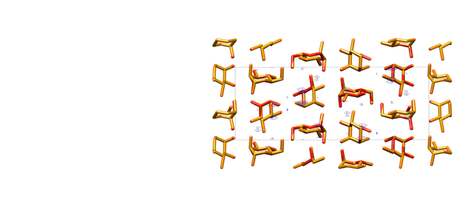
Modern powder X-ray Diffraction has a high: throughput, sensitivity to impurities, reliability, and temporal and angular resolution. Synchrotron beamlines and laboratory instruments are equipped with 1D and 2D hybrid-pixel X-ray detectors to cover a wide energy range: from 4 to 80 keV.
Read more →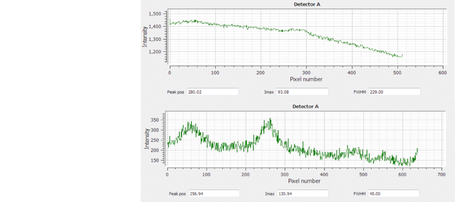
Residual Stress Measurements
Limitations of samples, such as fluorescence, size, and changes in time, can be overcome by implementing photon-counting X-ray detectors in various setups. These range from synchrotron sources to portable X-ray diffractometers.
Read more →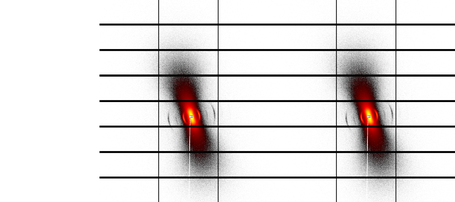
Wide-Angle X-ray Scattering (WAXS)
Wide-Angle X-ray Scattering (WAXS) probes crystalline and partially-ordered samples down to their atom-atom spacing. It is readily combined with Small-Angle X-ray Scattering (SAXS), even when using the same photon-counting detector.
Read more →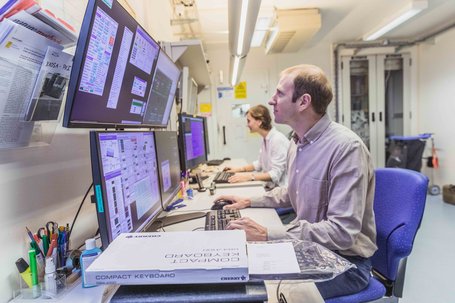
Wavelength Dispersive X-ray Fluorescence (WD-XRF)
The key feature of the WD-XRF technique is its high resolution. Can the resolution be increased further, without compromising measurement speed or sensitivity to weak signals?
Read more →
EXAFS & XANES
EXAFS and XANES have come to laboratory spectrometers, and the synchrotron techniques are moving forward. What is the role of hybrid-photon-counting detectors in this?
Read more → Related News
Request a quote
To get more information for a tender or learn more about purchasing a DECTRIS POLLUX™ X-ray detector for your laboratory, reach out to us
Want to know more?
We are happy to answer any questions about us, our detectors, or the process of integrating our detectors into your experimental setup.
Contact usNeed support?
Our Support team is here to answer your questions and help you take full advantage of your detector.
Support request